The Spinning Soul of a Clear Polycarbonate Discman (Circa 2003)
A witty, tragicomic tale of a translucent Sony Discman with 45-Second G-Protection facing down the smug, motionless rise of the pocket MP3 player.
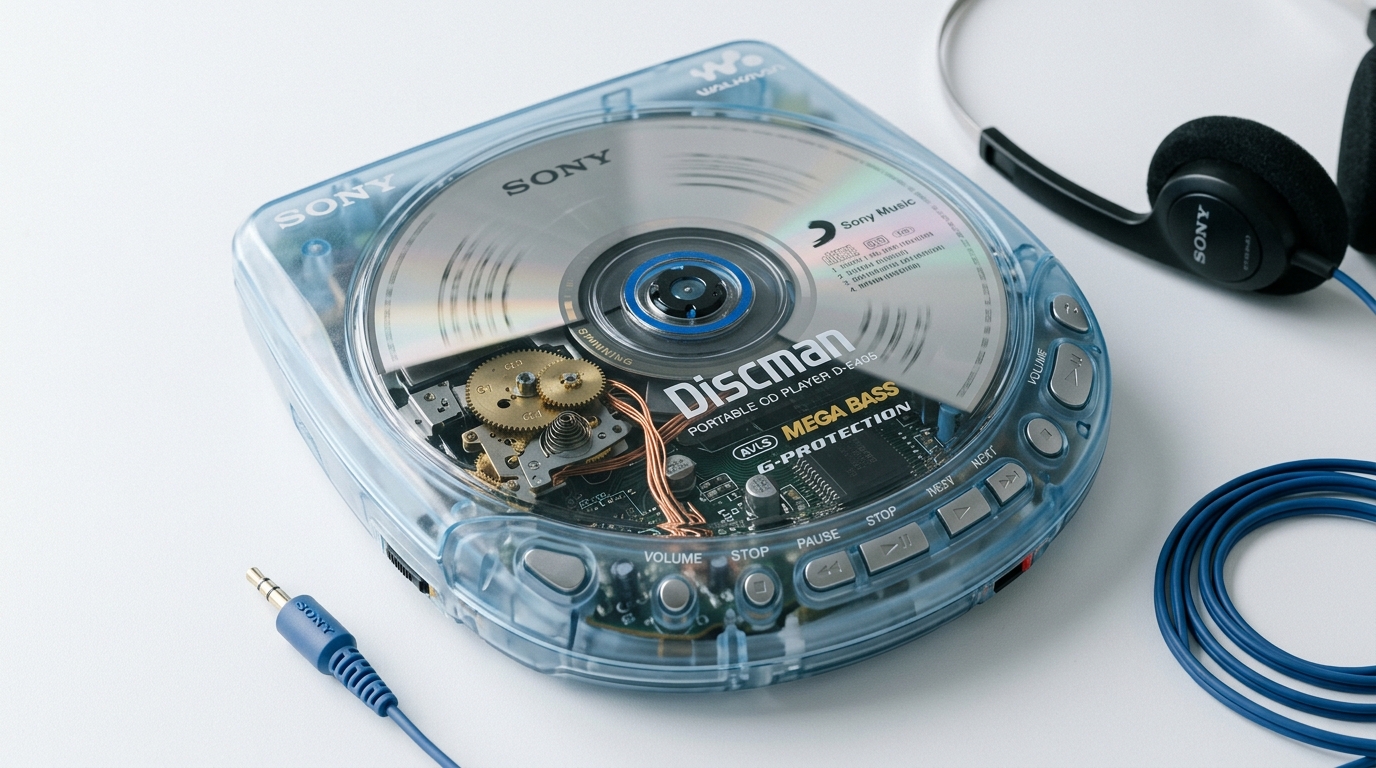
Let it be stated for the record: I was not built to be modest.
I was molded in January of 2001 out of pure, high-density, non-yellowing Japanese polycarbonate. My upper clamshell lid was entirely clear—so clear, in fact, that if you held me up to the fluorescent tubes of a suburban Circuit City, you could observe every trace on my circuit board, every miniature copper spring, and the optical laser carriage sliding along its dual brass rails like a tiny chrome train delivering raw symphonic joy.
And when Kevin snapped shut my lid, you could watch the compact disc actually rotate. Five hundred revolutions per minute. A blur of silver foil and pirated Limp Bizkit lyric sheets. That was the contract: you gave me two AA alkaline batteries, and in return, I provided physical proof of labor. I made a satisfying hydraulic shhh-whirrrr-clack that told everyone on the school bus: Quiet down, high culture is being ingested here.
Then came October 2003. And with it, the Pebble.
Memo Regarding the Device Known as The Pebble
Kevin called it an “MP3 player,” but to me, it looked like an overpriced motel soap.
It was opaque. Matte white. No hinges. No lens assembly. No moving parts whatsoever. It didn’t hum; it didn’t click; it didn’t smell faintly of warm printed circuit board and ozone after forty minutes of continuous playback. You couldn’t see inside it at all. It was just a smug little block of solid-state flash memory that Kevin slid into his front pocket without even giving it a protective neoprene slipcase.
“Look at this, dude,” Kevin told his friend Bradley on the front porch steps. Kevin was tapping a tiny black-and-white LCD screen with his thumb. “It holds one hundred and twenty-eight megabytes. That’s thirty-two songs. Encoded at 96 kbps. Sounds like it was recorded inside a wet cardboard box underwater, but who cares? It doesn’t skip when you jog.”
Doesn’t skip when you jog?
I sat there on the glass coffee table, my translucent Bondi-tinted rim catching the afternoon sunlight, vibrating with quiet synthetic indignation.
Excuse me? Had Kevin forgotten about my 45-Second G-Protection Electronic Shock Buffer?
In March of 2002, Kevin had dropped me down seven flights of concrete bleachers during an away track meet in Paramus, New Jersey. Did I stop playing track four of The Marshall Mathers LP? I did not. My buffer held thirty-eight seconds of digital audio in its silicon cache like a courageous soldier holding the fortress gates. I rattled, I bounced off a gym teacher’s clipboard, but the kick-drum never faltered. That was character. That was craftsmanship.
The Dignity of the Burned CD-R
The Pebble had no respect for ceremony. To load songs onto it, Kevin clicked a grey mouse twice and dragged a folder full of files named things like linkin_park_in_the_end_real_rip_NO_VIRUS.mp3.
Where was the sacrifice in that?
True music required an ordeal. True music required Kevin to sit in front of his family desktop tower until 1:45 in the morning with a stack of blue Memorex 700MB CD-Rs, praying to three different pagan deities that Nero Burning ROM wouldn’t throw a “Buffer Underrun Error” on the final ninety seconds of the disc.
It required him to carefully write “Summer Jamz ‘03 // DO NOT TOUCH” on the disc surface with a dry-erase Sharpie whose chemical fumes mildly eroded the reflective dye.
When you inserted that disc into my bay, pressed the center spindle until the three spring-loaded steel ball bearings went CLICK, and locked the clasp: you weren’t merely accessing data. You were docking a spacecraft.
A Final Spin on the Nightstand
By the spring of 2004, the migration was complete.
Kevin’s desk had become a graveyard of obsolete plastic grandeur. Beside me lay a translucent turquoise pager that hadn’t beeped since homecoming, and an iMac G3 that his mother now used exclusively to print lemon meringue pie recipes from AOL.
The Pebble ruled supreme. It had grown in capacity. Now it held five hundred songs. Kevin walked around with earbuds so thin they looked like dental floss, his eyes glazed with the terrifying gluttony of unlimited access. He skipped tracks after seven seconds. If an intro took too long, he thumbed forward with ruthless modern impatience. He no longer listened to track ten—the weird acoustic ballad the band buried at the end of the album because they knew only the faithful would let the laser travel that far out to the outer polycarbonate edge.
Late on a Tuesday night before graduation, the power went out. A summer thunderstorm knocked down the neighborhood transformer. The house went pitch black.
The computer went silent. The router blinked out. The Pebble’s rechargeable lithium battery was dead because Kevin had lost the proprietary grey USB dock behind his dresser.
In the dark room, Kevin sat on his bed, listening to the rain on the windowpane.
His hand wandered across the nightstand. His fingers brushed against my cold, ribbed acrylic edge. He paused. He picked me up.
He opened my clear door. It made that familiar, gentle spring-loaded thump. He reached into his drawer, pulled out two fresh Energizer AA batteries, and clicked them into my underbelly. From his backpack, he pulled an old silver jewel case.
He loaded the disc. He snapped the lid.
My laser awoke. A faint crimson pulse illuminated my frosted blue interior, casting delicate spiderwebs of circuit traces onto the ceiling. The spindle spun. Shhh-whirrrr-clack.
The buffer filled: 10 seconds… 25 seconds… 45 seconds of pure, uncompressed, unstreamed, tangible music.
Through the clear plastic, Kevin watched the silver disc twirl in the dark. For the first time in eighteen months, he didn’t skip a single song.
TRANSLUCENT DISPATCH & DROP ALERTS
Get notified when limited-run clear mechanical keyboards, refurbished Sony Discman units, and Atomic Purple handheld drops go live.