The Lofree 1% Review: Can German Bayer Polycarbonate Resurrect the Soul of the Clear Keyboard?
An exacting teardown and enthusiast buyer's guide covering the Lofree 1% transparent mechanical keyboard—analyzing German Bayer polycarbonate purity, Kailh Jellyfish switches, and real-world desk durability.
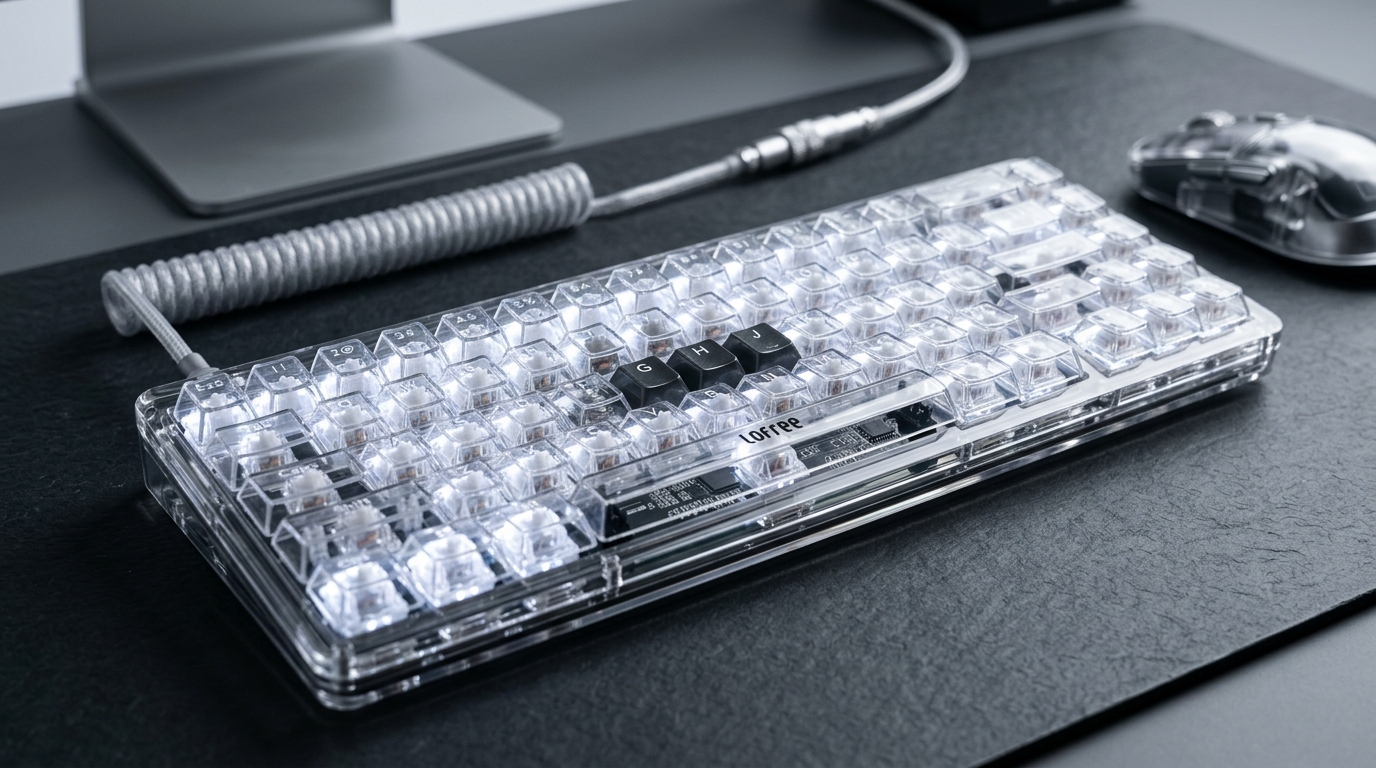
For the past decade, the mechanical keyboard hobby has been gripped by an obsession with heavy, anodized aluminum rectangles—dense metal bricks finished in matte black or industrial grey that conceal their internal circuitry like an embarrassing family secret.
The Lofree 1% Dual-Mode Transparent Keyboard rejects that sterile orthodoxy with brazen confidence.
Forged from high-purity German Bayer optical-grade polycarbonate and anchored by an electroplated mirror base, this 65% compact board turns every keystroke into an optical light show. Reminiscent of the crystalline Apple Pro Keyboard that sat beside the 2000 Power Mac G4 Cube, the Lofree 1% invites you to inspect its solder pads, stabilizer wire tracks, and switch stems in broad daylight.
Behind that icy, glass-like spectacle, however, lies an urgent question for the discerning typist: does this $219 statement piece deliver genuine acoustic refinement, or is it merely high-fashion plastic destined to collect fingerprints and hairline micro-scratches?
Here is our comprehensive teardown, acoustic benchmark, and buyer’s guide.
1. Material Science Teardown: Bayer Polycarbonate vs. Cast Acrylic
The single biggest engineering hurdle in transparent consumer electronics is optical refractive purity.
Many budget transparent keyboards flood the market using cast acrylic (PMMA) or recycled styrene. While inexpensive, acrylic suffers from two fatal flaws on a mechanical desktop: it generates a shrill, plasticky bottom-out sound (“clack”), and its structural rigidity makes standoff screw bosses prone to spiderweb stress fractures under torque.
Lofree bypassed standard commodity plastics by partnering with Germany’s Bayer MaterialScience to mold both the outer chassis and keycaps from virgin optical polycarbonate (PC):
- High Light Transmittance: The casing achieves near-glass optical clarity without the yellow-green tint typical of lower-grade polymers.
- The “High-Profile Boat” Case: Instead of exposing naked switch stems along the sides like floating-key gaming boards, Lofree engineered a high-bezel structural tub that conceals the switch housings, creating the illusion of floating ice cubes.
- The Electroplated Mirror Sub-Chassis: Beneath the white fiberglass PCB lies a vapor-deposited mirror plate. Rather than letting backlight spill uselessly onto your desk mat, this reflective floor bounces photons back upward through the clear switch housings, creating an ambient halo effect across the entire bottom row.
2. Switch Mechanics: The Kailh Jellyfish Deep Dive
A transparent keyboard falls flat if the mechanical switches inside feature opaque black nylon bottoms.
To preserve uninterrupted optical flow, the Lofree 1% utilizes custom Kailh Jellyfish switches engineered exclusively with crystal-clear polycarbonate housings and matching transparent stems:
| Switch Specification | Measured Value | Engineering Notes |
|---|---|---|
| Switch Architecture | Linear (Non-Clicky) | Zero tactile bump; seamless vertical drop |
| Housing & Stem Material | Bayer Optical Polycarbonate | 100% transparent; reveals gold leaf contacts & stainless spring |
| Actuation Force | 40 ± 10 gf | Featherlight actuation ideal for rapid typing |
| Pre-Travel | 1.8 ± 0.4 mm | Slightly faster trigger than standard Cherry MX (2.0mm) |
| Total Key Travel | 4.0 mm full stroke | Complete bottom-out landing on dense PC plate |
| Factory Lubrication | Krytox-equivalent synthetic grease | Pre-lubed sliders and spring ends; eliminates scratchiness |
In typing tests, the switches glide with silk-like consistency. Because the housings are pre-lubricated at the factory, there is none of the coarse friction or high-frequency spring ping that often plagues transparent plastic builds.
3. Acoustic Sound Profile: Does It “Thock”?
The timeless fear with all-plastic keyboards is that they will sound hollow—like tapping a plastic salad container with your fingernails.
Lofree solved this not through thick multi-layer foam sandwiches, but through mass and material density. Because the Bayer polycarbonate shell is over 3.2mm thick and weighs over 810 grams, it naturally absorbs high-pitched resonance:
- Alphanumeric Keys: Yield a surprisingly muted, raindrop-like tone with a soft bottom-out.
- Stabilized Keys (Spacebar, Enter, Backspace): Factory-packed with heavy synthetic lube on the wire clips, completely neutralizing wire rattle out of the box.
- Acoustic Rating: 7.5 / 10 for enthusiasts seeking a clean, crisp “marble drop” sound profile rather than a deep, muffled foam mutedness.
4. Real-World Trade-Offs & Quirks (Read Before Buying)
Transparency demands compromise. If you are adding the Lofree 1% to your daily workflow, consider these non-negotiable realities:
⚠️ The Fingerprint Factor
Smooth, glossy polycarbonate keycaps look pristine on camera, but they are unforgiving in real life. Within thirty to forty minutes of active typing, natural finger oils will produce visible smudge spots under directional desk lamps.
[!TIP] Care Guide: Keep a dedicated microfiber cloth at your desk. NEVER use isopropyl alcohol wipes or harsh chemical solvents on polycarbonate; alcohol triggers immediate micro-crazing (hairline frosted cracking) within the polymer structure. Use warm water and mild dish soap only.
⚠️ White Ice Backlighting Only (No RGB)
If your aesthetic vision requires pulsing rainbow spectrums, look elsewhere. The Lofree 1% features strictly single-color white LEDs with seven brightness and pulse patterns. We consider this an aesthetic triumph—resembling an illuminated glacier rather than a carnival arcade—but RGB enthusiasts may find it restrictive.
⚠️ Keycap Lock-In
Because the entire keyboard’s visual identity relies on the exact curvature and light refraction of Lofree’s custom PC keycap set, swapping keycaps defeats the entire purpose of the hardware. You are married to this profile.
5. Specs & Benchmark Comparison
How does the Lofree 1% stack up against our other favorite transparent desk keystones?
| Specification | Lofree 1% Transparent | KiiBOOM Phantom 81 V4 | Yunzii X75 Pro |
|---|---|---|---|
| MSRP | $219.00 | $159.00 | $89.99 |
| Chassis Material | German Bayer Polycarbonate | CNC Milled Acrylic | Injection Molded PC |
| Layout | 65% Compact (68 Keys) | 75% Layout (82 Keys) | 75% Layout (82 Keys) |
| Weight | 810g | 1,200g | 780g |
| Switches | Kailh Jellyfish Linear (Clear) | KiiBOOM Crystal Linear | Yunzii Transparent Linear |
| Lighting | Single Ice-White Glow | South-Facing Full RGB | South-Facing Full RGB |
| Connectivity | Bluetooth 5.1 + USB-C | 2.4GHz + BT + USB-C | 2.4GHz + BT + USB-C |
| Target Aesthetic | Luxury Minimalist Ice Sculpture | Maximalist RGB Heavyweight | Budget Everyday Daily Driver |
6. The Clear Tech Verdict
The Lofree 1% Dual-Mode Transparent Keyboard is not a utilitarian tool for spreadsheet warriors who eat potato chips over their keyboard. It is a high-concept piece of functional sculpture designed for typists who treat their desk like an architectural exhibit.
By investing in genuine German Bayer polycarbonate and custom Kailh Jellyfish switches, Lofree has created the finest modern homage to the translucent design golden era of the turn of the millennium. If you are willing to keep a microfiber cloth nearby, it is the most striking mechanical keyboard on the market today.
Recommended Dual-Cart Setup:
- The Modern Benchmark: Pick up the Lofree 1% Transparent Keyboard ($219) for zero-compromise desktop clarity.
- The Vintage Companion: Pair it with an authentic Vintage Apple Pro Keyboard M7803 on eBay ($45–$80) to complete the ultimate two-decade translucent evolution setup.
TRANSLUCENT DISPATCH & DROP ALERTS
Get notified when limited-run clear mechanical keyboards, refurbished Sony Discman units, and Atomic Purple handheld drops go live.